The costliest trading psychology mistakes and how to spot them in your journal
Revenge trading, FOMO, overtrading, moving your stop and cutting winners early. How to recognize each mistake, measure what it costs you and build rules to avoid it.
Two traders with the same strategy can get opposite results. The difference is almost always execution: what they do after a loss, how they react when price runs without them or when a trade starts going against them. This guide covers the most expensive psychological mistakes and, above all, how to make them measurable with a trading journal.
Why psychology can be measured
"I need to control my emotions" is a fine wish, but it isn't a plan. What you can do is tag each trade with the mistake you made (if any) and with your dominant emotion. After a few weeks, your journal tells you how much each mistake cost you in R. That number is far more convincing than any motivational quote.
1. Revenge trading
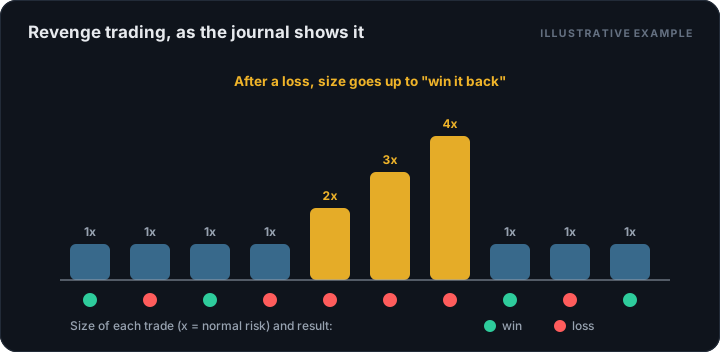
What it is: right after a loss, jumping into another trade, often bigger and without a setup, to "win it back".
How it shows up in your journal: trades taken shortly after a loss, larger size than usual and the note "didn't meet the plan".
Rule to prevent it: a mandatory pause after a loss (for example, 15 minutes away from the screen) and a daily loss limit. Hit the limit and the day is over.
2. FOMO (fear of missing out)
What it is: entering late on a move that already happened because "it's leaving without me".
How it shows up: entries far from the setup's ideal point, wide stops or none at all, and an actual risk/reward much worse than planned.
Rule: if the entry isn't inside your defined zone, there's no trade. The market will offer another opportunity tomorrow; a blown account won't recover tomorrow.
3. Overtrading
What it is: taking more trades than your strategy generates, out of boredom, anxiety or to "make the most of the day".
How it shows up: days with far more trades than average, and a clearly lower win rate on those days. Compare the expectancy of your first two trades of the day with that of your fifth and later ones: the gap is often striking.
Rule: a maximum number of trades per day, decided before you open the chart.
4. Moving the stop
What it is: pushing the stop further away as price gets close, "to give it room".
How it shows up: losses larger than −1R. If your journal often shows losses of −1.8R or −2.5R, this is the problem. Often a single moved stop erases the profits of several good trades.
Rule: the stop only moves in your favor (to breakeven or to lock in profit), never against you. A real stop order in the market, not a "mental stop", helps a lot.
5. Cutting winners early
What it is: exiting as soon as the trade is in profit, for fear it will turn around.
How it shows up: actual risk/reward far below plan. You plan 1:2 but your winners average +0.8R. With that number your win rate has to be extremely high to make money (see win rate and risk/reward).
Rule: define the exit before you enter and log every time you exit outside the plan. Check what the trade would have made if you had let it reach the target.
6. Overconfidence after a winning streak
What it is: after several wins in a row, raising size, loosening criteria or taking lower-quality setups.
How it shows up: your worst losses come right after your best days.
Rule: size is set by a fixed rule (for example, 1% of current equity), not by your mood.
How to build your own analysis
- Pick a short list of mistake tags and always use them the same way.
- Log your dominant emotion on every trade.
- At the end of the month, add up the R result of the trades with each tag.
- Pick one mistake to work on next month, with a concrete rule.
- Next month, measure whether that mistake showed up less and how much your results improved.
Here's how a real example looks: "Trades tagged revenge were 9 this month and totaled −7.5R. Without them, the month would have ended at +6R instead of −1.5R." After reading that, a 15-minute pause no longer seems excessive.
Summary
Psychological mistakes aren't solved with willpower but with information and rules. Tag them, measure what they cost you, work on one at a time and let your journal show you the progress.