How to keep a trading journal (a complete step-by-step guide)
What a trading journal is, why it is the tool that improves traders the most, and how to build a simple routine to log, review and correct your trading.
Almost every trader who improves steadily has one habit in common: they write down what they do and they review it. A trading journal is not a diary of memories or a place to vent. It is a database of your own decisions, and it is the only source of information that talks exclusively about your way of trading.
This guide covers what a trading journal is, the concrete benefits it brings and how to keep one with a routine that takes no more than ten minutes a day.
What a trading journal is
A trading journal is an organized record of every trade you take: the instrument, the direction, your entry and exit prices, how much you risked, how much you made or lost and, above all, why you took the trade and how you felt when you did.
The difference from your broker's history is huge. The broker tells you what happened. The journal tells you why it happened and whether it will happen again. Your broker statement shows you lost 300 dollars on Tuesday. A journal can reveal that you lose almost every time you trade the first half hour, or that your biggest losses come right after a winning trade.
Why it works
Trading has a peculiar problem: the outcome of any single trade has a lot of randomness in it. You can do everything right and lose, or everything wrong and win. That makes it very hard to learn from individual trades. Learning shows up when you put many trades together and look for patterns.
A well-kept journal lets you:
- Measure your real edge. Win rate, risk/reward, profit factor and expectancy calculated from your data, not from a course's promises.
- Separate process from outcome. A trade that followed your plan and lost is a good trade. One that broke your rules and won is a problem that hasn't cost you money yet.
- Spot repeated mistakes. Moving the stop, chasing entries, trading out of boredom. Once you tag them, they stop being feelings and become numbers.
- Build confidence on evidence. When you know your strategy worked over 150 trades, a five-loss streak won't make you abandon it.
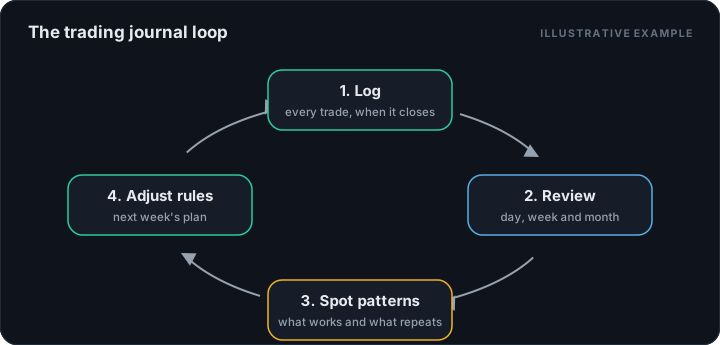
Step 1: decide what you will log
You don't need fifty fields. Start with the essentials and add more only if you will actually analyze them. A good starting point:
- Entry and exit date and time.
- Instrument and direction (long or short).
- Entry price, stop loss, target and exit price.
- Position size and risk in money.
- Result in money and in multiples of risk (R).
- Setup or reason for the entry.
- Whether you followed the plan.
- Dominant emotion and a short note.
- A chart screenshot.
The guide on what to log for each trade has a full template with examples for every field.
Step 2: log in the moment, not at the end of the week
Memory is a poor witness. By Friday you'll remember the big trades and rebuild your reasons with hindsight. Log each trade as soon as it closes, or at least at the end of the session. If your tool calculates the result and the stats for you, logging comes down to filling in a few fields.
Step 3: review daily, weekly and monthly
Logging without reviewing doesn't do much. A simple routine:
- Daily review (5 minutes): did you follow the plan on every trade? Is a mistake repeating? Write down a single lesson.
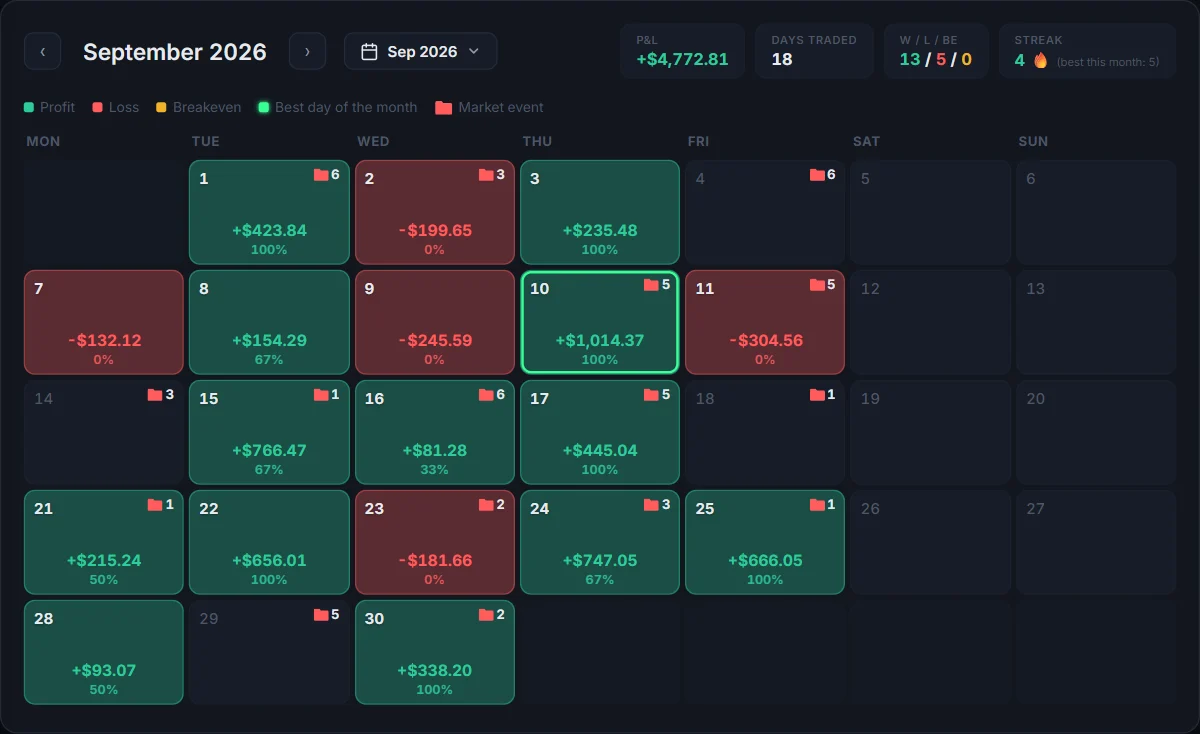
- Weekly review (20 minutes): look at your results calendar, win rate and average win versus average loss. Find which days or hours were worst.
- Monthly review (1 hour): compare setups. Which one has the best expectancy? Is there one you should stop trading? Check the month's maximum drawdown.
Step 4: turn what you see into rules
The ultimate goal of a journal is to change your behavior. Every review should end with one concrete, measurable action. For example:
A few weeks later, the same journal will tell you whether the rule worked.
Common journaling mistakes
- Logging only the winners or "forgetting" the worst trades. The journal stops being reliable.
- Logging too much and quitting after ten days. A few fields every day beat many fields for one week.
- Not using risk as the unit. Comparing trades in dollars mixes different sizes. Measuring in R (multiples of what you risked) makes every trade comparable.
- Looking only at total P&L. A green month can hide a bad process, and a red one can simply be variance.
How long until you see results
Around 30 trades are usually enough to spot obvious mistakes. To draw statistical conclusions about a strategy, aim for at least 100 trades of the same setup. Consistency is the key: an incomplete journal leads to wrong conclusions.
Summary
A trading journal is the cheapest and most effective way to improve: you log every trade with its reasons, review on a fixed routine and turn what you learn into concrete rules. It takes no special talent, just the discipline to write things down and the honesty to look at the data.