How to pass a prop firm challenge: rules, drawdown and a risk plan
How prop firm evaluations work, the difference between static and trailing drawdown, and a concrete risk plan to avoid blowing the account.
Prop firms let you trade company capital after passing an evaluation. It sounds simple: hit a profit target without breaching a loss limit. Yet most evaluations are failed, and rarely for lack of a strategy. They're failed because traders don't understand the drawdown rules and risk too much trying to reach the target quickly.
Every firm has its own conditions, and they change over time. Before you start, read the official rules of the account you bought carefully. This guide explains the concepts that show up in almost all of them.
The most common rules
- Profit target. A percentage or amount you need to reach, often between 6% and 10% of the balance during the evaluation phase.
- Daily loss limit. How much you can lose in a single day. Hit it and you lose the account or the day is closed, depending on the firm.
- Maximum loss or maximum drawdown. The overall limit. It can be static or trailing, and that difference is key.
- Minimum trading days and, at some firms, a maximum time window.
- Consistency rule. Some require that no single day accounts for more than a certain share of total profit.
- Restrictions on trading news, holding overnight or over the weekend.
Static versus trailing drawdown
Static: the limit stays fixed relative to the starting balance. On a $100,000 account with a 10% maximum loss, the account fails if equity reaches $90,000, no matter how much you made before.
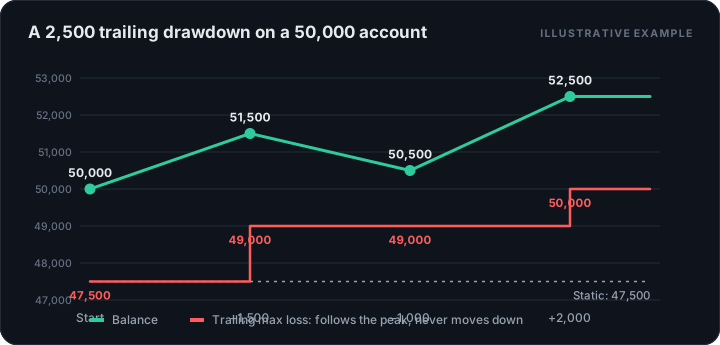
Trailing: the limit rises as the account makes new highs. It's common on futures accounts. For example, on a $50,000 account with a $2,500 trailing drawdown:
| Moment | Account high | Maximum loss level |
|---|---|---|
| Start | 50,000 | 47,500 |
| You make 1,500 | 51,500 | 49,000 |
| You lose 1,000 | 51,500 | 49,000 (doesn't drop) |
| You make 2,000 | 52,500 | 50,000 |
The limit follows the high but never moves back down. Many firms stop it once it reaches the starting balance. When the high is measured also matters: some firms use the end-of-day balance and others track it in real time, including open profit. In the latter case, a trade that was up $1,000 and closed flat still raised your limit.
The main mistake: sizing for the target
If you need $3,000 in profit and have $2,500 of loss room, it's tempting to risk $500 or $1,000 per trade to finish in a few days. The problem is that at that size, 3 to 5 losses in a row (a normal occurrence) end the evaluation.
The right question isn't "how much do I need to make?" but "how many losses in a row can I survive?".
A concrete risk plan
- Set your risk as a fraction of the allowed drawdown, not of the balance. With $2,500 of room, risking $250 per trade (10% of the room) lets you survive 10 losses in a row. At $125 (5%), 20.
- Set your own daily limit, tighter than the firm's. For example, 2 losses or half the official daily limit. You stop before a bad day becomes unrecoverable.
- Cut size near the limit. If your remaining room falls by half, halve your risk.
- Build a cushion early. Early profits widen your room on accounts with a static limit; on trailing accounts, the cushion only builds once the limit stops rising.
- Don't change strategy during the evaluation. Trade exactly what you've already tested in your journal or in a backtest.
Check whether your strategy can pass
With your real statistics you can estimate whether the evaluation is achievable. If your expectancy is +0.25R and you risk $250, each trade is worth about $62 on average. For a $3,000 target you'd need around 48 trades on average, with bad streaks along the way. If the firm gives you 30 days and you take 2 trades a day, the plan is reasonable. If you take 3 a week, it isn't: you'll end up forcing trades or raising risk, and that's where mistakes start. See trading expectancy.
Keep a separate record per account
If you run several accounts (evaluations, funded accounts and a personal one), log them separately. Each has its own limit, its own drawdown and its own target. A journal that shows, for each account, how much room is left before the limit saves you from the worst surprise: finding out an account was lost to a rule you weren't watching.
Summary
Passing an evaluation is above all a risk management exercise. Understand how your account's drawdown is calculated, risk a small fraction of the available room, set daily limits stricter than the official ones and trade only what you've already proven works.